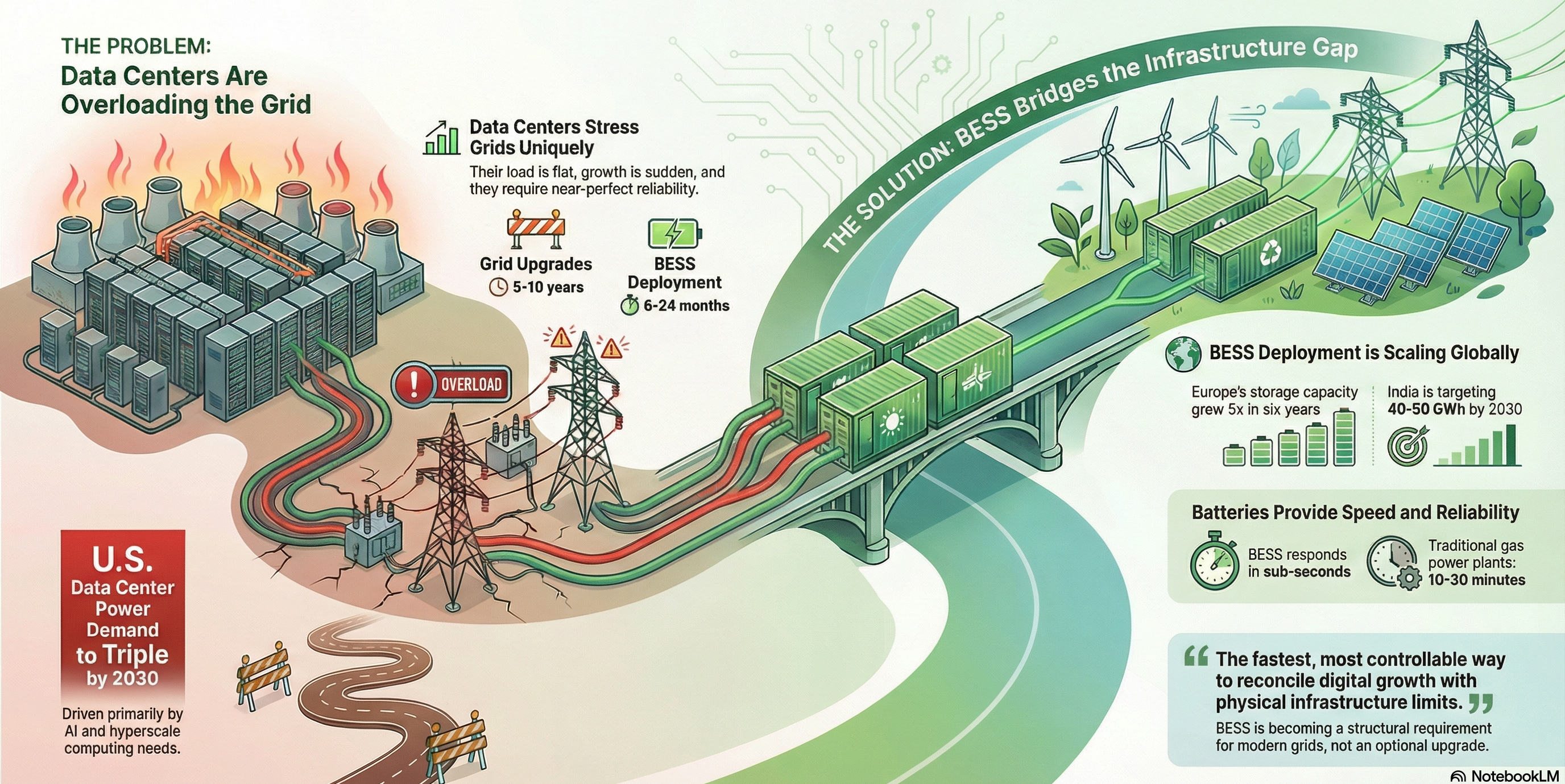
Data centers are no longer a marginal load on the grid. They are becoming one of the fastest-growing electricity demand segments globally, and their growth rate is outpacing the infrastructure meant to serve them. By late 2025, government and regulatory data across the US, EU, and India all point to the same conclusion:
Battery Energy Storage Systems (BESS) are becoming a structural requirement—not an optional upgrade—for grids absorbing data-center growth.
Let’s look at the numbers.
The Load Growth Problem
The grid has telemetry and market mechanisms for flexibility—but flexible load alone is not fast enough. BESS converts flexibility into dispatchable, time-critical capacity. U.S. data-center electricity demand is projected to double or triple by 2030, driven by AI and hyperscale compute. Based on December 2025 assessment reports from Federal Energy Regulatory Commission (FERC):
- 33.3 GW of demand response available.
- ~6.5% of total wholesale peak demand.
- 128.4 million advanced meters (76.8% coverage).
European planners are no longer asking whether batteries help — they are now counting on them in adequacy calculations. The winter outlook of ENTSO-E 2025-26 suggests that storage is increasingly counted toward resource adequacy margins, not just ancillary services. According to the European Commission’s Joint Research Centre (JRC) November 2025 storage assessment: Grid-connected battery storage in Europe has moved from <10 GWh (2019) to >50 GWh installed or contracted by 2025.
Countries like India have moved BESS from pilot projects to national infrastructure planning, precisely as data-center and digital demand accelerates. India's Q4 2025 government disclosures are especially revealing:
- Ministry of Power confirmed ~13–14 GWh of BESS projects under implementation or tendering, supported by Viability Gap Funding (VGF).
- Public trajectories align with 40–50 GWh of grid-scale BESS by ~2030.
- Formal tariff treatment for efficiency and dispatch.
Why Data Centers Force the Issue and Why BESS is needed
Data centers—especially those supporting AI and hyperscale workloads—are fundamentally different from traditional loads. They run flat and hard, 24/7, with almost zero tolerance for interruption. What’s changed is the speed and scale of growth: instead of incremental increases, data-center demand is arriving in GW-scale step changes, with power requirements projected to rise by up to 160% by 2030 as synchronized GPU clusters proliferate. Traditional grid solutions move too slowly: transmission upgrades take 5–10 years, while BESS can be deployed in 6–24 months. With sub-second response, battery storage bridges power-quality events, congestion, and interconnection constraints faster than any other asset. That timing mismatch is the core reason BESS is no longer optional for data centers—it’s becoming foundational infrastructure.
The AI boom has quietly turned Battery Energy Storage Systems from grid add-ons into electrochemistry-limited infrastructure. After years of flat demand, data centers are now driving GW-scale, step-change load growth, with projections showing they could consume 6.7–12% of U.S. electricity by 2028.
As a battery scientist and engineering lead, this is no longer a simple capacity problem; it’s a chemistry and durability problem under extreme operating conditions. LFP has become the preferred choice for data centers because it offers superior thermal stability, a benign failure mode, and reliable performance at high temperatures and high C-rates compared with Ni-rich chemistries. Other technologies have defined roles—iron-air for long-duration shifting, Li-S if cycle-life challenges are resolved, and flow batteries where longevity outweighs footprint—but rising rack densities from ~8 kW to >30 kW now impose fast transients and high thermal loads that expose weak designs. Better battery chemistry is no longer a secondary design choice; it is a critical constraint in data-center expansion.
Bottom Line
The data is consistent across continents: We cannot scale data centers at today’s pace using yesterday’s grid assumptions. Battery Energy Storage Systems are not just supporting the grid — they are becoming the fastest, most controllable way to reconcile digital growth with physical infrastructure limits.
For engineers and planners, the key question is no longer “Should we deploy BESS?” It’s “Are we sizing, siting, and valuing it correctly for the loads that are coming?”